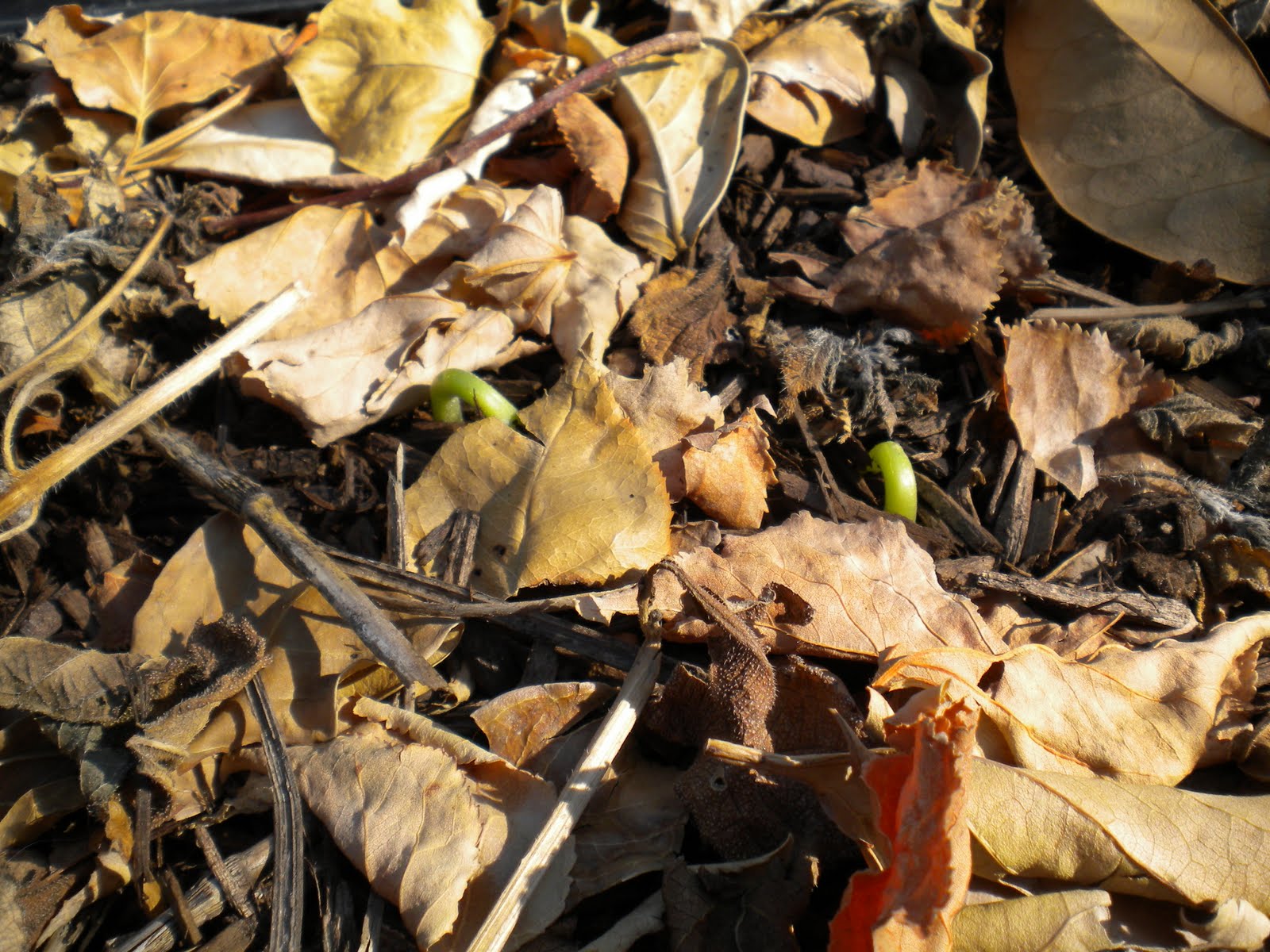
 My Summerfelt beans are starting to emerge! Growing dry beans (as opposed to green/string beans) is the easiest! You just plant and water (and fertilize if you remember!), then wait for the beans to dry on the bush. Once they are dry, just pick the pods and pop the beans out. If you really want to make it easy, put the dry bean pods in an old pillow case and let the kids jump on it! Or, put the pillow case with beans by a door that gets a lot of traffic and let the people walk on it. Then, you can pour out the beans and blow off the chaff. My Dad and I like to sit and shell the beans while watching TV. Store the beans in a jar on the shelf, where they will remain good for many years.
Thursday, July 28, 2011
Beans Are Up!
My Summerfelt beans are starting to emerge! Growing dry beans (as opposed to green/string beans) is the easiest! You just plant and water (and fertilize if you remember!), then wait for the beans to dry on the bush. Once they are dry, just pick the pods and pop the beans out. If you really want to make it easy, put the dry bean pods in an old pillow case and let the kids jump on it! Or, put the pillow case with beans by a door that gets a lot of traffic and let the people walk on it. Then, you can pour out the beans and blow off the chaff. My Dad and I like to sit and shell the beans while watching TV. Store the beans in a jar on the shelf, where they will remain good for many years.


Wednesday, July 27, 2011
Tomato Problems . . .
 My husband's tomato plant has a problem. The top and bottom of the plant looks fine, it's just the middle part that is dying out. I will have to look into the problem, and let you know what it is tomorrow. Any guesses??
Tuesday, July 26, 2011
Topping Semi-Dwarf Fruit Trees
 These are my semi-dwarf apricot trees. I recently topped these and my pear trees. If I didn't top them and head back some of the branches, they would just keep growing until the trees were 15' tall and many feet wide. I had an semi-dwarf apricot tree years ago and I didn't realize that they would grow so large. It got away from me and grew quite tall and wide. The tree ended up with a disease a couple of years later and had to be taken out. Now I know I have to keep my trees in check! It is hard to cut happily growing branches, but it pays off in the end. I will be able to harvest my fruit while standing on the ground, instead of trying to steady myself on a ladder; my trees will not take over the neighboring fruit trees (they are planted close together); and they won't be hanging over the fence to drop fruit in my neighbor's yard. I've always thought that what hung over the fence into your yard was yours--to prune it back, to enjoy the shade, or to harvest the fruit; but, I don't want to burden my neighbor just because I didn't keep my trees in line, so I keep them pruned. I do have a semi-dwarf almond tree that I have never pruned, and it is about 20' tall, but it has been there for over 30 years, and no one has complained.
Monday, July 25, 2011
Summerfelt Beans
 Last Friday I got my Summerfelt beans planted. I also covered the garden with plant trays to keep my three kitties out! Once the beans are up and growing, I will remove the trays.
 These are some of my Summerfelt beans. They taste really good when made into "Navy" Bean Soup!
Sunday, July 24, 2011
Citrus Tree Leaves
 If you have a citrus tree (orange, lemon, lime), you may see a lot of dead leaves underneath its canopy. A few weeks back we had several daytime temperatures of 107' or more. This is the response if my orange tree. When the heat is high, the tree can't always keep up with the moisture loss, so it drops some of its leaves.
Saturday, July 23, 2011
Dill Pickles
Pickling cucumbers are different than regular eating cucumbers. The picklers (top cuk in the picture) have "spines", kind of like cactus. The spines are black or white, and are scrubbed off with a vegetable brush. If they don't all come off, that's OK, the pickling brine will dissolve them. The pickling cucumber will stand up to the brining process, but the eating cucumbers (bottom cuk in the picture) may just go to mush (I've not tried it). Pickling cucumbers can be eaten fresh, just make sure the spines are gone!
 I find that I need to plant dill two weeks before I plant the pickling cucumbers, so the dill will have the flower heads that are used in the pickles. The picture below is of one head of dill. Each little flower will ripen to make a seed, if left to mature in the garden.
 Dill Pickle Recipe:
To each scalded quart jar add:
1/8 teaspoon alum
1 clove of garlic
2 heads of dill
1 hot pepper, optional
sliced pickling cucumbers
For the brine:
1 quart cider vinegar
1 cup pickling or non-iodized salt
(not table salt, it will turn the
brine cloudy)
3 quarts of water
Heat brine to boiling; pour over the
cucumber mix above; seal with
scalded lids, and tighten rings.
Allow 6 weeks for pickling, then eat!!
 Here's what they look like. I'm the only one in my home that eats them, so I canned them in pints. They are so good!
 I find that I need to plant dill two weeks before I plant the pickling cucumbers, so the dill will have the flower heads that are used in the pickles. The picture below is of one head of dill. Each little flower will ripen to make a seed, if left to mature in the garden.
 Dill Pickle Recipe:
To each scalded quart jar add:
1/8 teaspoon alum
1 clove of garlic
2 heads of dill
1 hot pepper, optional
sliced pickling cucumbers
For the brine:
1 quart cider vinegar
1 cup pickling or non-iodized salt
(not table salt, it will turn the
brine cloudy)
3 quarts of water
Heat brine to boiling; pour over the
cucumber mix above; seal with
scalded lids, and tighten rings.
Allow 6 weeks for pickling, then eat!!
 Here's what they look like. I'm the only one in my home that eats them, so I canned them in pints. They are so good!
Friday, July 22, 2011
My Apologies . . .
I can't believe it's been over two months since I last posted! Life got busy, I forgot to post, and then I was out of the habit of posting--I will do better this time. My veggies are growing like weeds, and the harvest is going on like crazy. I have had a lot of tomatoes (made into chunks, and sauce, and then canned), a big mess of green beans (also canned), and lots of chard. The chard had volunteered the last few generations, growing willie-nillie, and I finally cleared it out. Now I have a box that I will plant my Summerfelt beans in. I found the Summerfelts several years ago in the Seed Saver's catalog; they are a dry bean, great for soups, and a little sweeter than Navy beans. My grandmother's maiden name was Summerfelt, so when I found the beans, I just had to have some! They originated from a man with the last name of Summerfelt, in Germany, in 1810--he could be an ancestor of mine!
 This is a picture of my husband's tomato plant (I sure wish I could remember the name of it!)---it's about 6' tall. It has produced a lot of tomatoes, more than I expected, and has kept growing and producing (it's indeterminate, which means it keeps growing until a killing frost). The tomatoes are kind of mealy and don't have a lot of juice, so they are making some good sauce! My Roma tomatoes are producing well (they are determinate, they stop growing at about 3').
 These are my green beans, with cucumbers on the trellis behind them. I have made dill pickles this year--it's been years since I made them. I love dill pickles, and they are so easy to make! I will have to post my recipe, so you can see how easy they are.
 This is a picture of my husband's tomato plant (I sure wish I could remember the name of it!)---it's about 6' tall. It has produced a lot of tomatoes, more than I expected, and has kept growing and producing (it's indeterminate, which means it keeps growing until a killing frost). The tomatoes are kind of mealy and don't have a lot of juice, so they are making some good sauce! My Roma tomatoes are producing well (they are determinate, they stop growing at about 3').
 These are my green beans, with cucumbers on the trellis behind them. I have made dill pickles this year--it's been years since I made them. I love dill pickles, and they are so easy to make! I will have to post my recipe, so you can see how easy they are.
Subscribe to:
Posts (Atom)